Michael A. Henson Group
Department of Chemical Engineering
University of Massachusetts Amherst
Molecular Modeling of Bacterial Quorum Sensing Systems
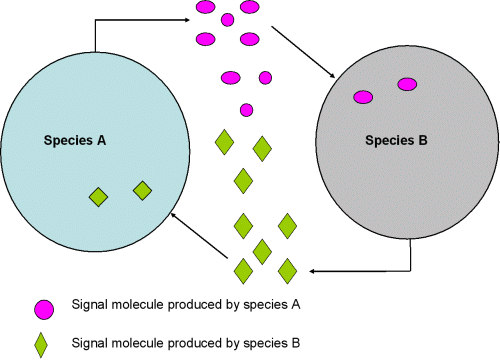
The objective of this project is to develop an integrated experimental and modeling program for the synthetic design of bacterial quorum sensing systems. We envision that these engineered systems will have a wide range of potential applications including microbial fermentation, chemical detection, and ecosystem analysis. Our initial work has focused on the conceptual design of a two-species artificial bacterial cooperative ecosystem (symbiosis) in which the survival of one species is dependent on the cell density of the other species. A simple dynamic model of this synthetic ecosystem has been used to investigate the stability of competitive cell strains in continuous culture with a single growth limiting substrate. Bifurcation analysis shows the existence of multiple steady-state solutions, including two non-trivial solutions for the coexistence of the two species. One coexistence solution is stable over a wide range of dilution rates and produces large variations in the fractions of the two species, suggesting that the proposed design has potential applications in competitive mixed culture fermentations by allowing stable production of two microbial populations with different growth rates. Our current work is focused on experimental realization of this synthetic ecosystem design and more fundamental modeling at the gene/protein level.
Funding: UMass
Student: Pavan Kumar Reddy Kambam (4th year Ph.D.)
Collaborator: Prof. Lianhong Sun (UMass, primary advisor)
Publications:
- Kambam, P. K. R., M. A. Henson and L. Sun, "Design and Mathematical Modeling of a Synthetic Symbiotic Ecosystem," IET Systems Biology, 2, 33-38 (2008). [PDF]
Molecular Design of a Synthetic Symbiotic Ecosystem
Predicted Stabilization of a Competitive Mixed Chemostat Culture
