Click on the link to see details


Click on the link to see details
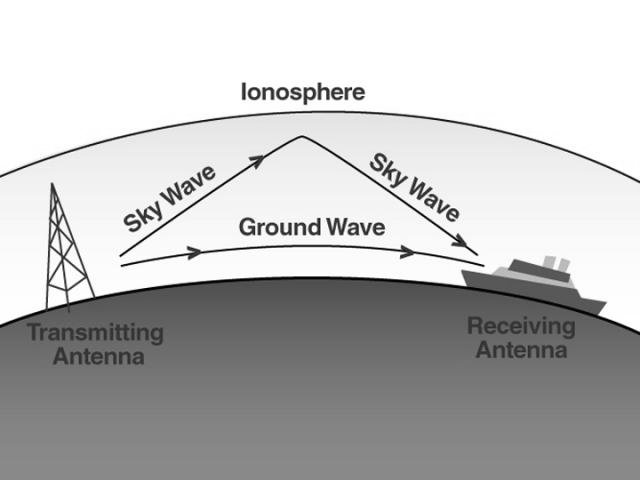
We are exploring the use of random walk methods for the solution of wave propagation problems. Our initial efforts are directed towards finding efficient techniques for solving the parabolic wave equation. A four-state random walk (FRW) model has been found to be attractive in this regard.
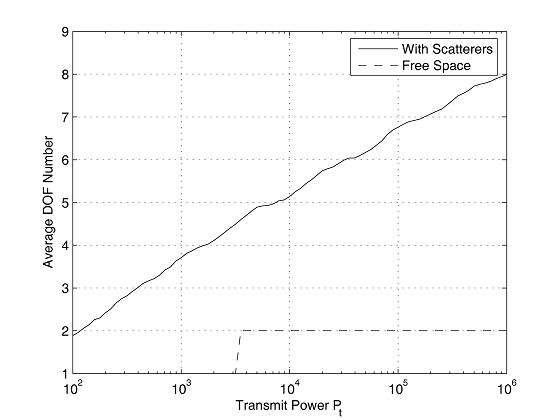
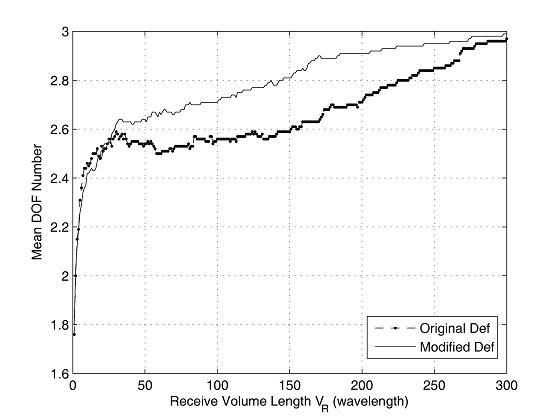
Multiple Input Multiple Output (MIMO) systems are very attractive for increasing the information carrying capacity of wireless systems operating with limited bandwidth. Employing electromagnetic methods we are making studies on the available degrees of freedom of MIMO systems in a rich multipath environment when the receiving signals are corrupted by noise. The degrees of freedom approximately give a sense of the number of modes that can be utilized for MIMO communications. Fig. 4a shows the average number of degrees of freedom as a function of transmit antenna power. Fig. 4b shows the average number of degrees of freedom as a function of the receive volume size.
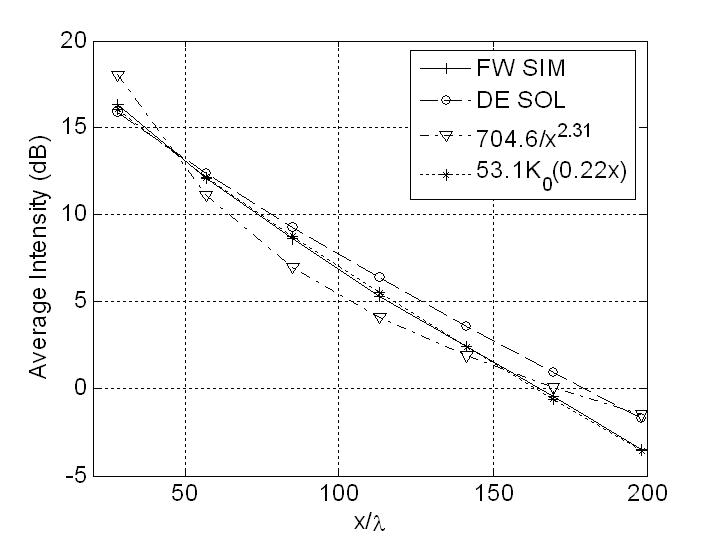
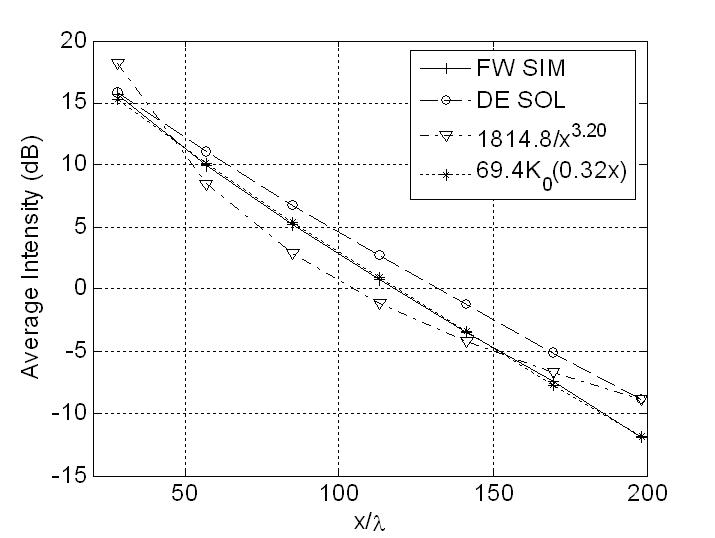
Another related topic is to use non-exact methods to model path loss in rich scattering environments. We are exploring the use of diffusion equation to model mean path loss as a function of distance from the transmitter. Fig. 5a and 5b show the received power as a function of distance from transmitter using a full-wave integral equation model together with the analytical one predicted by diffusion equation. A mixture of lossy objects with cross-sectional shapes chosen from circular, square, and elongated elliptical shapes were included in the full-wave approach. The cylinders were scattered with random locations and orientations within the scattering volume.
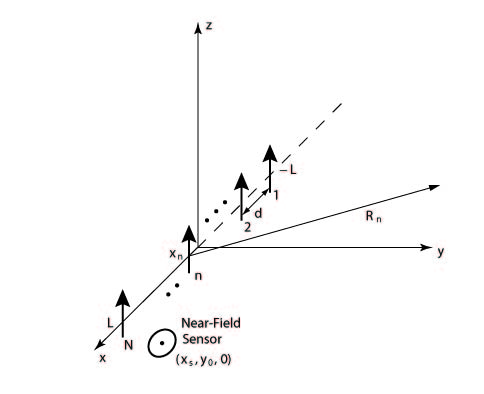
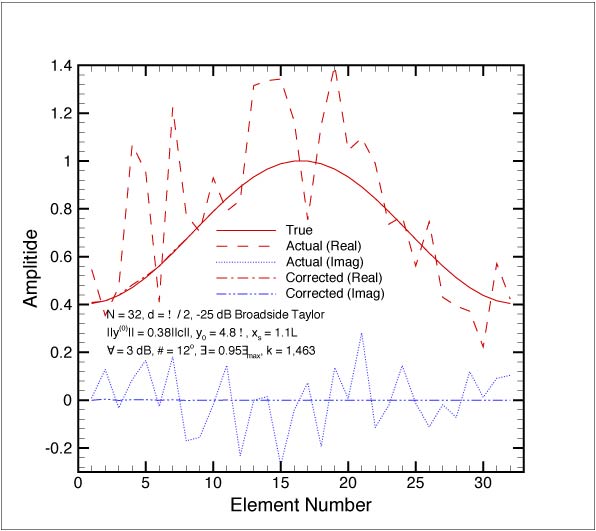
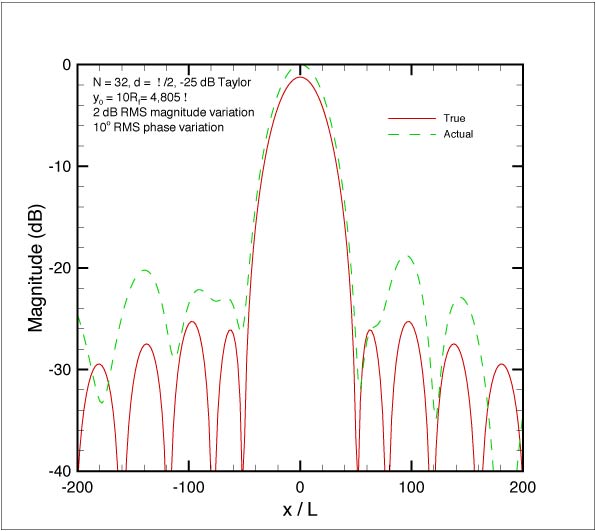
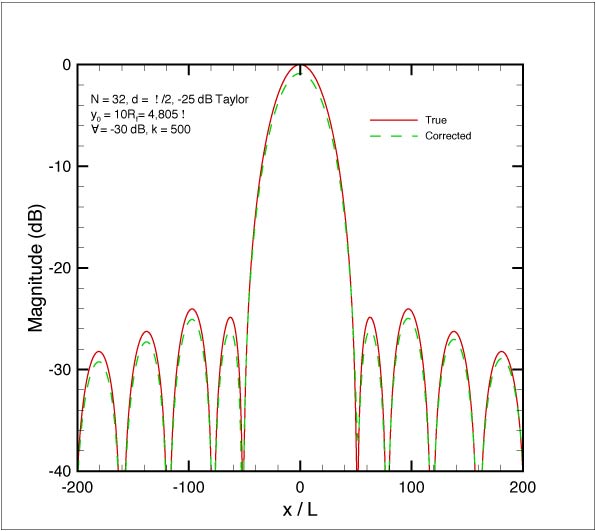
Phased arrays are employed in a number of electronic systems ranging from radar systems to communications systems. The excitation coefficients of a phsed array may drift from the desired values to a number of electronic and mechanical reasons. We are exploring the use of dithering and near-field sensing to automatically correct for the errors in the excitation coefficients in near-real time. A gardient based algorithm is used to drive the erroneous coefficients towards the true coefficients. Preliminary results for linear arrays employing half-wave dipoles have yielded encouraging results. The figures below show the geometry of the linear array, desired and actual (erroneous) coefficients, and the desired, actual, and corrected far-field patterns. Extentions to planar arrays is being presently undertaken.