Model-based development of stable nanoparticle dispersions
Solid lipid nanoparticles (SLNs) have great potential as delivery systems for the encapsulation, protection and release of active lipophilic compounds (e.g., drugs, nutraceuticals, antimicrobials, antioxidants and vitamins) in the pharmaceutical, agrochemical, food and personal care industries. SLNs are commonly prepared by making a hot oil-in-water nanoemulsion using high pressure homogenization followed by controlled cooling so that the fluid lipid droplets crystallize and produce solid nanoparticles. A major obstacle to the widespread industrial use of SLNs is their tendency to aggregate when stored at ambient temperatures. Aggregation is driven by the lipid phase undergoing a polymorphic transformation from the thermodynamically unstable α-form to the stable β-form. Along with several other research groups, we have shown that SLN aggregation can be substantially reduced or even eliminated by mixing specific low-melting point oils with the molten lipid prior to homogenization to form so-called nanostructured lipid carriers (NLCs). To facilitate widespread industrial acceptance of NLCs, improved understanding of the stabilization mechanism and the development of systematic methods for designing stable systems are needed.
We have investigated the effects of different carrier oils on the aggregation stability of NLCs stabilized with nonionic surfactant in water. We found that the carrier oil type and concentration strongly affected NLC aggregation behavior. Increasing carrier oil concentrations yielded increasingly stable dispersions while reducing NLC crystallization and melting temperatures. Furthermore, increasing carrier oil concentrations increased the polymorphic transformation rate such that negligible -particle content was observed at carrier oil concentrations that yielded stable dispersions. Cryogenic TEM images showed that increasing carrier oil concentrations produced more spherical particles. Taken together, these experimental results suggest that carrier oil trapped within the growing lipid crystal matrix accelerates the polymorphic transformation but retards the large shape change normally associated with the transformation. Dynamic simulations with a population balance equation model suggested the carrier oil also could enhance the ability of surfactant to stabilize the NLC suspensions.
Funding: Procter & Gamble
Student: Yihui Yang (4th year Ph.D. student)
Collaborator: Al Corona (Procter and Gamble), Surita Bhatia (Stony Brook University)
Recent Publications:
- 1. Yang, Y., A. Corona III and M. A. Henson, “Experimental Investigation and Population Balance Equation Modeling of Solid Lipid Nanoparticle Aggregation Dynamics,” Journal of Colloids and Interface Science, 374, 297-307 (2012). [PDF]
- 2. Atmuri, A., M. A. Henson and S. R. Bhatia, “Predicting Regimes of Controlled Nanoparticle Aggregation,” submitted for publication. [PDF]
|
A 
|
B 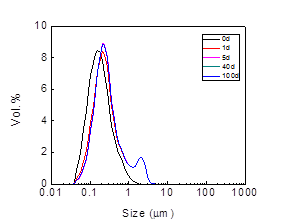
|
|
C 
|
D 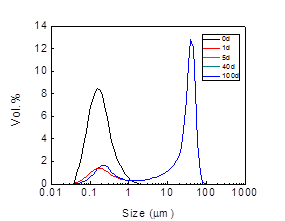
|
Aggregation dynamics of triolein-tristearin NLCs: (a) Measure evolution of particle size distribution for 10wt% triolein-tristearin NLCs with different surfactant concentrations; (b) simulation result for low maximum surface coverage value; (c) simulation result for medium maximum surface coverage value; (d) simulation result for high maximum surface coverage value.