Population balance equation modeling of emulsification processes
Oil-in-water emulsions are ubiquitous dispersed phase systems with diverse applications including natural and processed foods. Emulsion system formulation and processing operations both impact the drop size distribution, a key property that influences dispersion rheology, stability, texture, appearance and food safety. The population balance equation (PBE) modeling framework is particularly well suited for emulsification processes because functions describing single droplet events such as breakage and coalescence can be incorporated within a fundamental number balance equation to predict the evolution of the drop size distribution. While PBE models have been developed for a wide variety of emulsification processes including high pressure homogenizers, these models are typically formulated for prediction at constant and relatively low oil fractions. We have incorporated coalescence into a breakage-only PBE model of high pressure homogenization to allow prediction of drop size distributions at high oil-to-surfactant ratios. While the model was capable of accurate prediction at a constant oil concentration, extensibility to other oil concentrations proved to be unsatisfactory.
We have developed an improved PBE model that allows prediction of homogenized drop size distributions over a wide range of oil concentrations. Our model oil-in-water emulsion system consisted of 1% Pluronic F68 non-ionic surfactant and 10-50% vegetable oil. Our previous PBE model was modified in two important ways: (1) a new mechanistic function for drop breakage due to turbulent shear was developed and combined with a previous breakage function for drop collisions with turbulent eddies; and (2) the constant continuous phase viscosity used in the breakage and coalescence functions was replaced with an emulsion viscosity calculated using a model that describes the shear thinning behavior of the emulsion as a function of the oil concentration. Nonlinear optimization was used to estimate viscosity model parameters and adjustable parameters in the breakage and coalescence functions from viscosity and drop distribution data collected at 10% oil. The resulting model was shown to produce satisfactory emulsion viscosity and drop size distribution predictions at 30% and 50% oil without re-estimation of the model parameters.
Funding: Unilever, National Science Foundation
Student: Shashank Maindarkar (4th year Ph.D. student)
Collaborators: Hans Hoogland (Unilever)
Recent Publications:
- Raikar N. B., S. R. Bhatia, M. F. Malone, D. J. McClements, C. Almeida-Rivera, P. Bongers and M. A. Henson, "Prediction of Emulsion Drop Size Distributions with Population Balance Equation Models of Multiple Drop Breakage," Colloids and Surfaces A: Physicochemical and Engineering Aspects, 361, 96-108 (2010). [PDF]
- Raikar, N. B., S. B. Bhatia, M. F. Malone, D. J. McClements and M. A. Henson, "Predicting the Effect of Pressure on the Drop Size Distributions of Homogenized Emulsions," Industrial Engineering and Chemistry Research, 50, 6089-6100 (2011). [PDF]
- Maindarkar, S., N. B. Raikar and M. A. Henson, “Incorporating Drop Coalescence in Population Balance Equation Model for High Pressure Homogenization,” Colloids and Surfaces A: Physicochemical and Engineering Aspects, 396, 63-73 (2012). [PDF]
- Maindarkar, S., P. Bongers and M. A. Henson, “Predicting the Effects of Surfactant Coverage on Drop Size Distributions of Homogenized Emulsions,” Chemical Engineering Science, 89, 102-114 (2013). [PDF]
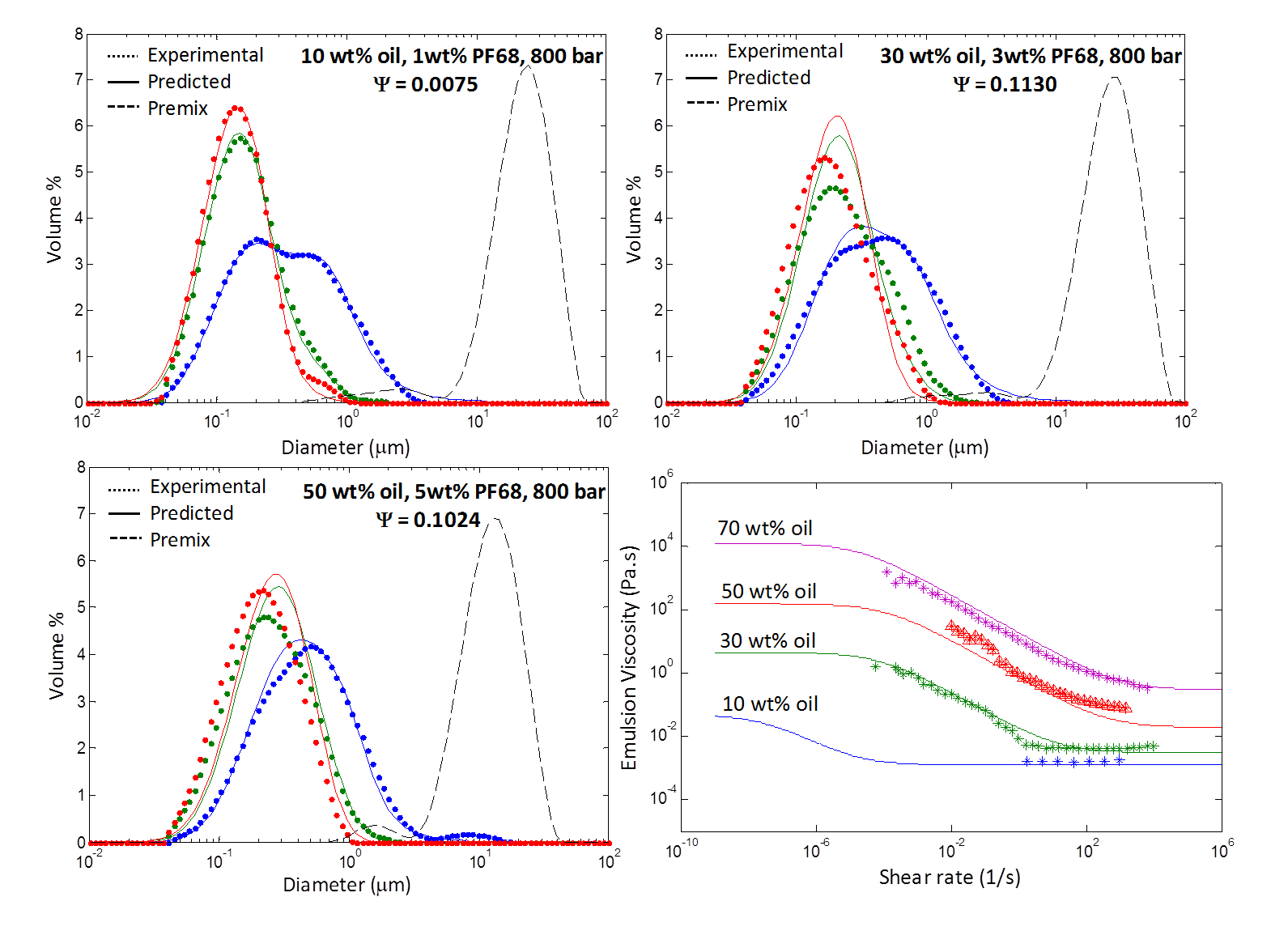
Prediction of drop size distributions and viscosities of homogenized oil-in-water emulsions with different oil weight fractions.