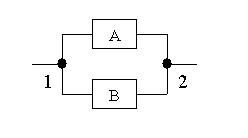
In this sample, we only have two parallel modules.
1. Input the configuration of the system
2. Click the first RUN, then you will get below:NodesNum=2 ModulesNum=2
InputNode=1 OutputNode=2
A=(1,2)
B=(1,2)
3. Input the numeric value of reliability for each module:Result:The diagram is shown below:
System Reliability = 1-(1-Ra)*(1-Rb)
4. Input the numeric value of failure rate for each module:0.9, 0.8Click the second RUN, then you will get below:Result:The diagram is shown below:
System Reliability = 1-(1-Ra)*(1-Rb)Given Ra = 0.9, Rb = 0.8
Rsystem = 0.98
Return1.5, 2.0Click the third RUN, then you will get below:Result:The diagram is shown below:
System Reliability = 1-(1-e-1.5t)*(1-e-2t)
The diagram of R(t) vs time t is shown below:At time t = 1, R(t) =.328268059962724


