Characterization of TOX Produced During Disinfection Processes
Project Team
Faculty PIs: David A. Reckhow, Patrick G. Hatcher
Graduate Students and Post-Docs: Guanghui Hua, and Junsung Kim, Sarah A.L. Caccamise and Rakesh Sachdeva
Journal Publications
Hua GH, Reckhow DA. Determination of Tocl,
Tobr and Toi in Drinking
Water by Pyrolysis and Off-Line Ion Chromatography. Analytical
and Bioanalytical Chemistry 2006; 384: 495-504.
Hua GH, Reckhow DA, Kim J. Effect of Bromide and Iodide Ions on the
Formation and Speciation of Disinfection Byproducts During
Chlorination. Environmental Science & Technology 2006;
40: 3050-3056.
Hua, Guanghui and Reckhow David A.
Characterization of Disinfection Byproduct Precursors Based on Hydrophobicity and Molecular Size. 2006 in review.
Hua, Guanghui and Reckhow David A. Comparison
of TOX formation from chlorine and alternative disinfectants. 2006 in review.
Hua, Guanghui and Reckhow David A. Factors Affecting the Formation of
Disinfection Byproducts during Chlorination and Chloramination.. 2006 in review.
Hua, Guanghui and Reckhow David A. Hydrophobicity and Molecular Size Distribution of Unknown
Halogenated Disinfection Byproducts in Drinking Water. In preparation.
Project
Report
Reckhow, David A., Hua, Guanghui, Kim, Junsung, Hatcher, Patrick G.,
Caccamise, Sarah A. L., and Sachdeva, Rakesh. Characterization of TOX Produced During
Disinfection Processes. 2007.
Presentations:
Hua, G., and DA Reckhow, “Determination of TOCl, TOBr, and TOI in Drinking Water by Pyrolysis and Off-line Ion Chromatography”, Proceedings of the Water Quality Technology Conference. 2004, AWWA, Denver, CO.
Hua, G., and DA Reckhow, “Effect of Bromide and Iodide Ions on the Formation and Speciation of DBPs During Chlorination”, Proceedings of the Water Quality Technology Conference. 2004, AWWA, Denver, CO..
Hua, G.., DA Reckhow, “Characterization
of Unknown TOX Precursors based on Hydrophobicity and
Molecular Size”, Proceedings AWWA Annual
Conference, June 12-16, 2005;
Hua, G., and DA Reckhow, “Determination of TOCl,
TOBr, and TOI in Drinking Water by Pyrolysis and
Off-line Ion Chromatography”, oral presentation, Water Quality Technology
Conference. November 16, 2004,
Hua, G.,
and DA Reckhow, “Effect of Bromide and Iodide Ions on the Formation and
Speciation of DBPs During
Chlorination”, oral presentation, Water Quality Technology Conference. November 17, 2004,
Hua, G.., DA Reckhow, “Characterization
of Unknown TOX Precursors based on Hydrophobicity and
Molecular Size”, oral presentation, AWWA
Annual Conference, June 12-16, 2005;
Sachdeva, R., PG Hatcher, S. Kim, AG Marshall, RP Rogers and DA Reckhow, „Characterization of Total Organic Halogen (TOX) Produced During Disinfection Processes by ESI-TOF MS and ESI-FTICR MS“ poster presentation, EMSI/North Central NOM Workshop, Columbus, OH, June 15-17, 2005
Hua, G.., DA Reckhow, “Comparison of total organic halogen formation from various disinfection processes”, oral presentation, Water Quality Technology Conference, November 6-10, 2005 (TUE1); Quebec City, Que.
Hua, G.., DA Reckhow, “Factors affecting the formation and destruction of TOX in drinking water”, oral presentation, Water Quality Technology Conference, November 6-10, 2005; Quebec City, Que.
Hua, G,
and DA Reckhow, “Comparison of total organic halogen formation from chlorine
and alternative disinfectants” oral presentation at the AWWA Annual Conference,
June 12, 2006,
Hua, G,
and DA Reckhow, “Hydrophobicity and molecular size distribution of unknown
halogenated disinfection byproducts in drinking water” oral presentation
at the Water Quality Technology Conference, , November 6, 2006,
Project Summary
Total organic halide (TOX) is an analytically defined measurement that is often applied to environmental waters, especially drinking waters. The intent of the TOX measurement is to provide an estimate of the total amount of organically-bound (i.e., by covalent C-X bonds) chlorine, bromine and iodine in a dilute water sample. The standard method for measuring TOX does not allow for separate determination of the various halogen species. Alternative TOX methods capable of differentiating between the halogens (i.e., TOCl vs TOBr vs TOI) are of interest to the water industry, because of the perceived toxicity of bromine and iodine containing disinfection byproducts.
Research Objectives
The purpose of this research was: (1) to determine the best TOX protocol for use with ion chromatography (IC) analysis for the purposes of discriminating between TOCl, TOBr and TOI. (2) to determine the nature and chemical characteristics of the unknown fraction of the total organic halogen (UTOX) produced during chlorination and alternative disinfection processes (i.e., chloramination, chlorine dioxide, ozone disinfection), and (3) to assess the impact of treatment on removal of UTOX precursors.
Approach
This work was conducted in several phases; and it built upon the latest fundamental advancements in NOM characterization. First, a series of TOX methodology studies were undertaken. This was needed to validate existing TOX methods before they could be reliably applied to the analysis of TOBr and TOI. Next, a survey of selected North American utilities was conducted. This involved the collection of waters of diverse quality and geographic location for laboratory treatment with 5 basic disinfection scenarios (chlorination, chloramination, both with and without preozonation, and chlorine dioxide). Analysis of these samples for TOX species and known DBPs was undertaken to help the researchers better assess the full range of UTOX occurrence and the raw water characteristics that are associated with higher levels. In addition, distribution system samples were fractionated according to hydrophobicity and molecular size, and then analyzed for UTOX. The next task focused on factors influencing UTOX concentrations, especially engineering factors. This task was designed to examine impacts of chemical conditions during disinfection on ultimate UTOX concentrations. The final phase was directed to the application of advanced chemical techniques (borrowed from the humic substances research field) to the characterization of UTOX. A set of innovative techniques were explored for assessing UTOX on a molecular level. Most prominent among these was electrospray ionization fourier transform ion cyclotron resonance mass spectrometry (ESI-FT-ICR-MS).
Conclusions
Modeling and Occurrence
Using laboratory data, an empirical model was developed
for Unknown TOX based on easily measured DBPs and
various reaction conditions. Test data
were extracted from the Information Collection Rule (ICR) federal database
allowing the calculation of known to unknown TOX quotients for hundreds of
waters across the
Based on the laboratory analysis of 6 contrasting waters, there is a broad range in HAA9/THM precursor ratios (0.8-1.7 on a weight basis) in North American NOM. This implies a substantial diversity in NOM types, especially considering that both THMs and HAAs are general oxidation end products of a wide range of organic molecules. The data also supported an earlier assertion that terrestrial and lignin-based precursors are both highly-absorbing and rich in HAA precursors as compared to THM precursors. Based on this set of waters, there appeared to be little difference in the UTOX/TOX ratios, suggesting that UTOX may not be a sensitive indicator of the quality of the unknown byproducts.
TOX Method Refinement
The pyrolytic analyzer using pure O2 and off-line IC combined with a standard TOX carbon (coconut based) achieved complete recovery of TOCl, TOBr and TOI from model compounds. The O2/CO2 pyrolytic system and off-line IC showed incomplete recovery for some samples due to condensation of halide ions and the difficulty in flushing these halide ions. The use of CO2 as an auxiliary gas resulted in interference in IC analysis, which made it necessary to purge dissolved CO2 before IC analysis. There was no obvious difference between the two analyzers when used in microcoulometric detection mode. The TOX method is moderately sensitive to nitrate rinse volume. The monohaloacetic acids were partly washed out during sample preparation. This problem was solved by modifying the nitrate rinsing procedure. Complete recovery was achieved for all the selected compounds by this modified TOX protocol. The two coconut based carbons (CPI-001 and CPI-002) gave nearly identical recoveries for natural water samples. The bituminous coal based carbon (F-600) suffered from excessive inorganic iodide retention.
Incorporation of Bromine and Iodine
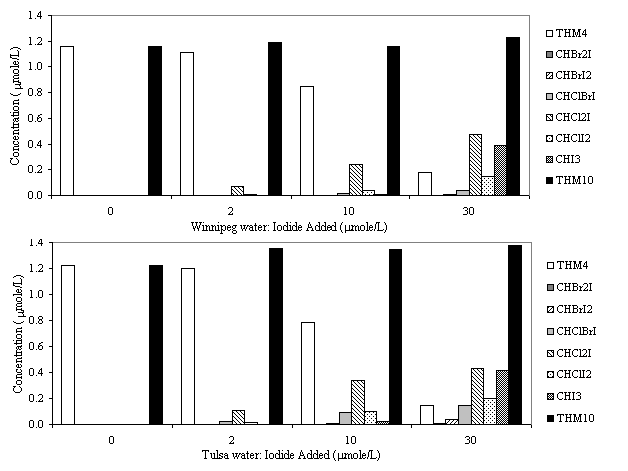
Molar yields of trihalomethanes (THMs) and haloacetic acids (HAAs) increased as the initial bromide ion concentration increased. No significant change in total organic halogen (TOX) concentration was found for varying bromide concentrations. However, TOX concentrations decreased substantially with increasing initial iodide ion concentrations. At higher levels of bromide, there was a decreasing level of unknown TOX and unknown total organic chlorine (UTOCl) but an increasing level of unknown total organic bromine (UTOBr). Bromine substitution into THMs and dihaloacetonitriles (DHAN) was shown to be more complete than into trihaloacetic acids (THAA) and dihaloacetic acids (DHAA). Generally, the order of bromine substitution was DHAN> DHAA& THM >THAA. The extent of iodine substitution was much lower than that of bromine substitution when comparing identical initial concentrations since a substantial amount of iodide was oxidized to iodate by chlorine. Increasing chlorine dose was able to control the formation of iodinated organic compounds. The Cl2/TOC or Cl2/I ratio is critical to the formation of iodinated disinfection byproduct (I-DBPs) and iodate (IO3-). While high levels of I-DBPs may be rare in practice, when they do occur, increasing chlorine dose is a feasible method to control the formation of these compounds. Low dose chlorination may result in a substantial amount of I-DBPs for iodide containing water.
TOX from Alternative Disinfectants
Preformed chloramines produced from 7% to 18% of the TOX produced by free chlorine. It should be noted that these experiments were designed to isolate the impacts of pure monochloramines, whereas full-scale systems always involve some exposure (sometimes transient) to free chlorine. Chlorine dioxide showed a slightly lower and narrower range (5%-8%). Preozonation usually resulted in less UTOX upon subsequent free chlorination. However, when followed by chloramination, the impacts of preozonation were of little benefit and more often detrimental. One water showed net increases in UTOX as a result of pre-ozonation regardless of the final disinfectant.
Characterization of UTOX Precursors
In tests using chlorination, hydrophobic and high MW (e.g. >3kDa) precursors produced more trihalomethanes (THMs), trihaloacetic acids (THAA) and unknown total organic halogen (UTOX) than corresponding transphilic, hydrophilic and low MW (e.g. <3kDa) precursors. However, the formation of THMs and THAA was similar among different fractions for a water with low humic content. Hydrophilic and low MW fractions (<0.5k) gave the highest dihaloacetic acid yields. No significant difference was found for dihaloacetic acid and UTOX formation among different fractions during chloramination. It appears that chloramination DBP precursors are more evenly distributed among NOM fractions. High pH favors the formation of THMs and HAAs over UTOX. Increasing pH also led to lower TOX formation for hydrophobic and high MW fractions, but had little impact on TOX yields from hydrophilic and low MW fractions. Bromine and iodine were found to be more reactive with hydrophilic and low MW fractions as measured by THM and HAA formation than their corresponding hydrophobic and high MW fractions. However, hydrophobic and high MW fractions produced more UTOX when reacting with bromine and iodine. A conceptual model was proposed involving aliphatic and aromatic precursors. This was used to bridge the empirical observations on halide incorporation with precursors of varying characteristics
Characterization of UTOX Compounds
Chemical and physical property based measurements (i.e., resin adsorption and membrane separation) indicate that most UTOX is in the mid-size range (0.5-10 kDa), but it can have a wide spectrum of partitioning properties or hydrophobicities. These sizes suggest that the bulk of the UTOX resembles halogenated fulvic acid molecules with little fragmentation, but substantial modification in the form of greater densities of hydrophilic groups (carboxylic acids) may occur. This material also seems to have a special affinity for XAD-4 over XAD-8 (i.e., transphilic) suggesting an intermediate polarity and aromaticity.
Effect of Reaction Conditions on UTOX Formation
In the early stages of chlorination reactions, UTOX compounds are formed preferentially at neutral and alkaline pHs. At acidic pHs the measureable byproducts and the unknown TOX seem to form at about the same rate. In pure chloramination processes the reverse occurs. Neutral to high pHs result in rapid formation of measureable byproducts (principally DHAAs), whereas the formation of UTOX is much slower. DHAAs form very quickly in both chlorination and chloramination scenarios. Unknown TOX also forms quickly by chlorination, but quite slowly by chloramination. In systems where chlorine is limiting (i.e., low doses and no residual), most of the TOX is locked up in UTOX compounds with very little THAAs. As higher doses are applied, the UTOX gives rise to high levels of THAAs. This occurs in both free and combined chlorine systems.
Corrosion control chemicals can impact DBP formation through pathways that probably involve general or specific base catalysis. For example, use of sodium hydroxide (up to pH 11) and silicate (at pH ~9.5) caused loss of TOCl, TOBr, and especially TOI. At the same time, it resulted in increases in chlorinated THMs, probably via hydrolysis of meta-stable trichloromethyl intermediates. The same phenomenon was observed for the DHAAs (chlorinated and brominated), but not the THAAs.
Characterization of Individual UTOX Molecules
Our analysis of the four water samples by electrospray time of flight mass spectrometry shows
spectral features characteristic of DOM
samples. The mass spectral data are very
complex and we also notice the increase in the complexity of data upon chlorination. Since the DOM samples have spectral intensity
every 2 Da apart, analysis of the isotope patterns
due to presence of halogen atoms in the molecules is not feasible at the
resolution of the TOF MS instrument.
The ultra-high
resolution mass spectral analysis of the samples on the 9.4 T
FTICR mass spectrometer at the National High Magnetic Field Laboratory at
The majority of the high intensity ions found in the ESI FT-ICR mass spectra are C, H and O based compounds. The halogenated DBPs that are C,H, O and halogen based compounds are believed to be the best molecular matches, based on known DBPs formed from other studies. These molecular formula matches are still preliminary, and the isotopic abundances still need to be verified in future work.
Originally, it was thought that the halogenated DBPs would occur at negative mass defects, but from the analysis performed so far, there are several halogenated DBPs that occur at positive mass defects. The mass defect is also based on the other elements and their number, and this can counteract the negative mass defect effect of the halogens. This complicates the analysis, because not only the negative mass defect ions can be analyzed to look at the DBPs, the whole data set needs to be considered.
Kendrick plots are useful in comparing data sets. These plots can also be helpful in the determination of homologous series in the data, which can aid in the data interpretation for the higher molecular weight components. Kendrick plots of the different disinfection processes show that there are a large number of components that do not lie within a homologous series related by a CO2 group. This means that there is a large number of components that do not contain only C, H and O, but have some other elements (chlorine?). The Cl2 treated water has a large number of components, and many have Cl included in their proposed molecular formulas. The other 4 disinfection processes show less deviation from the CO2 relationship, and have less chlorinated matches. This shows that the other disinfection processes create less halogenated DBPs, and C,H, O based components are formed from the oxidation of the DOM.
The two-dimensional van Krevelen plot of the chlorinated species in the